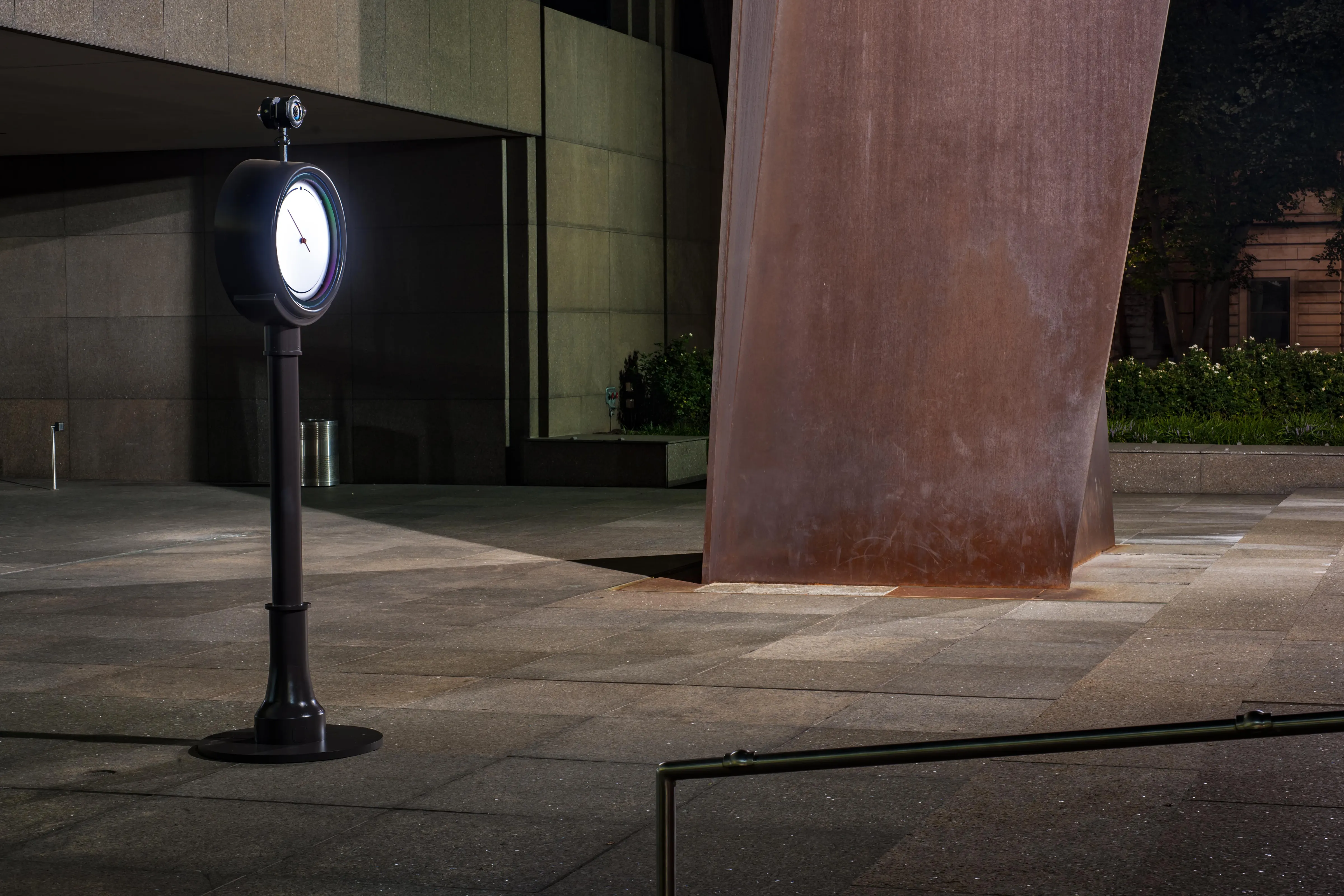
Late last year, the Hillman Photography Initiative at Carnegie Museum of Art (CMOA) invited the Innovation Studio to join planning discussions for its next cycle of activities, a calendar year filled with artist projects, events and public programming. Those discussions have coalesced nicely into LIGHTIME, which kicked off earlier this month and investigates photography as it relates to two of its most fundamental elements: light and time.
We’ve been working closely with museum staff over the past ten months to develop a physical identity for LIGHTIME’s slate of activities over the next year. Today, we’re super excited to share the Light Clock, a physical interactive installation on the museum’s public plaza and main entrance.
The Light Clock is actually comprised of two main components:
- The curious clock itself (outside the museum), which conveys the passing of time through a continuously swooping solitary hand. This hand makes a rotation every 5 minutes and each time it gets to the top, the clock captures a 360º image of the museum plaza. It will do this 24/7 for 15 months, resulting in hundreds of thousands of images. Every one of these images is instantly sent inside the museum to…
- An interactive visualization (in the museum lobby) that remixes the captured imagery into a participatory experience for museum visitors. We’ve installed several large displays and an interaction zone, where visitors physically spin their bodies to control their point-of-view (spinning left) and the lens of time (spinning right).
As you can imagine, there are many moving parts to this complex project, so we produced a documentation video that we think does a good job of succinctly summarizing our project process.
###The Process
As Caroline says in the documentation video, this project was the ultimate new media challenge. Our process began in December of 2015, when conversations with the Initiative’s leadership and artist agents landed on a fantastic quote from critical theorist Roland Barthes.
For me the noise of Time is not sad: I love bells, clocks, watches — and I recall that at first photographic implements were related to techniques of cabinetmaking and the machinery of precision: cameras, in short, were clocks for seeing, and perhaps in me someone very old still hears in the photographic mechanism the living sound of the wood.” ― Roland Barthes, Camera Lucida: Reflections on Photography
This concept — cameras as clocks for seeing — is driving every aspect of this cycle of the Hillman Photography Initiative, from the four artist-led projects through to our work with the clock. This quote has been our foundation and we regularly came back to it as we made design and experiential decisions throughout the project.
With the Barthes quote in the front of our mind, the Innovation Studio’s first step was to lead CMOA through a discovery process designed to unearth institutional goals and priorities, departmental objectives, aesthetic preferences, and logistical realities. We gathered the stakeholders together and held a series of discovery sessions through which we asked intentional questions like “What stories must the Light Clock tell?” and “Who uses the Light Clock?” and “What is your all-time favorite clock? Why?” These types of questions passively pulled out details that were important to the CMOA team. We then turned these findings into an extensive creative brief that ultimately defined the project requirements moving forward.
The nice thing about starting from scratch with a comprehensive discovery process was that we had the time and flexibility to complete several drafts of the creative brief. Getting the creative brief just right was crucial because it would be the document we would be responding to with our concept pitches. It’s at this point the project started to get fun. We took a few weeks to explore the craziest of concepts and follow loose but exciting ideas down into rabbit holes. And we invited really smart, talented people we respect greatly (like designer Brett Yasko) to probe these concepts with us. On the other side of all these exploratory activities we ended up with two solid ideas, one of which is the concept that stands in front of the museum today.
We pitched it. CMOA dug it. Now, to build it. It was already April and we were cruising quickly toward a CMOA target date of September 9th. From the beginning it became clear that this project had so many moving parts and would require participation/investment from many people and departments, not only within CMOA, but across Carnegie Museums of Pittsburgh. We would need a detailed requirements document to keep everyone on the same page with respect to timelines, roles/responsibilities, project scope and budget. Once these final details were formalized, we started designing and developing.
It turned out to be a busy summer the core Studio project team, which shook out to be myself, Caroline Record, Drew McDermott and Sam Ticknor. We don’t keep a clock maker on staff, so we partnered with Verdin Bells and Clocks, who proved to be up for the challenge. Tommy Verdin and his team became invaluable collaborators on this project, advising us on myriad mechanic, design and fabrication decisions.
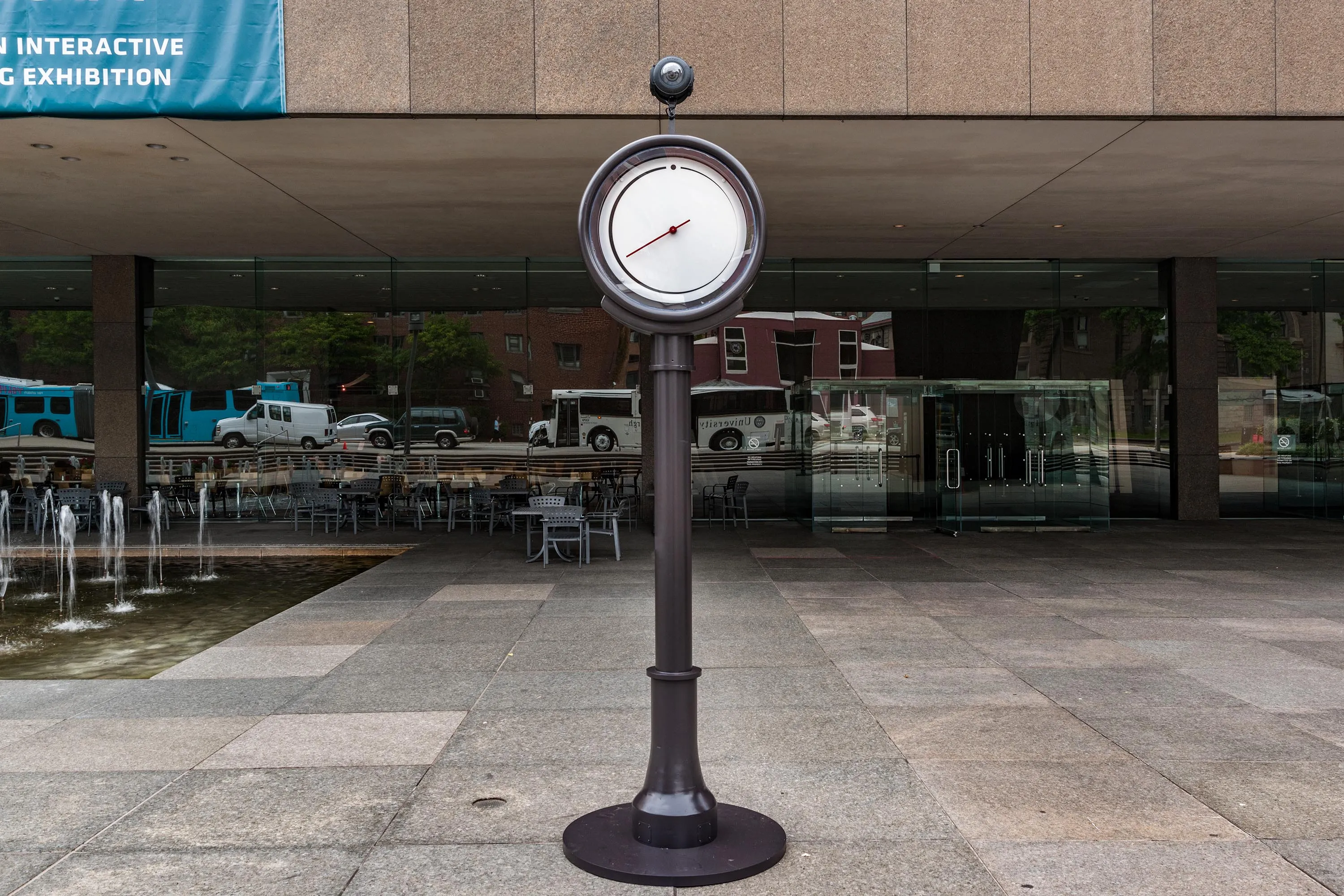
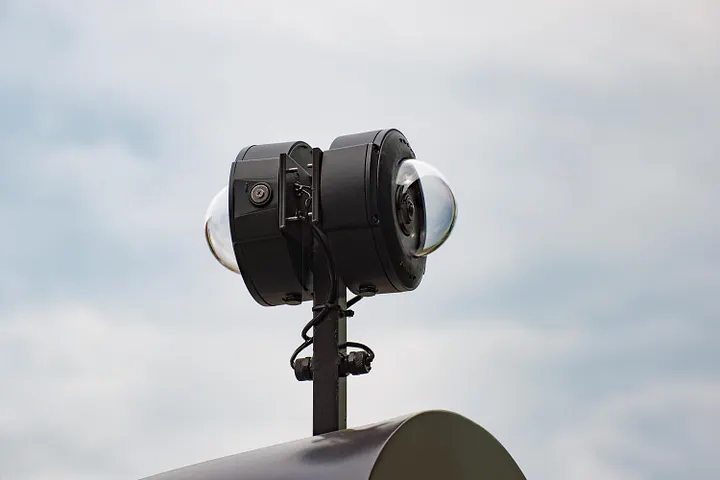
The 360º camera rig that sits atop the clock was a particularly interesting challenge for us to solve. Our requirements for the camera were that it needed to capture 360º imagery, it needed to be powered using Power-over-Ethernet (PoE) and it needed to be weathertight for an entire year of outside use. Nothing off the shelf existed that would meet these requirements, so we reached out to camera manufacturers and ended up working closely with surveillance company OnCam to invent a rig that would work for us.
While the outside components of the clock were very challenging, the visualization inside the museum also presented some large obstacles for us. Our initial concept for the visualization was a projection, but we quickly discovered that light levels through the lobby’s wall of windows were too high to support projection within our project budget. So we changed course to focus on a matrix of digital displays, and ultimately settled on several 70" monitors hung in portrait orientation to form a subtle semicircle.
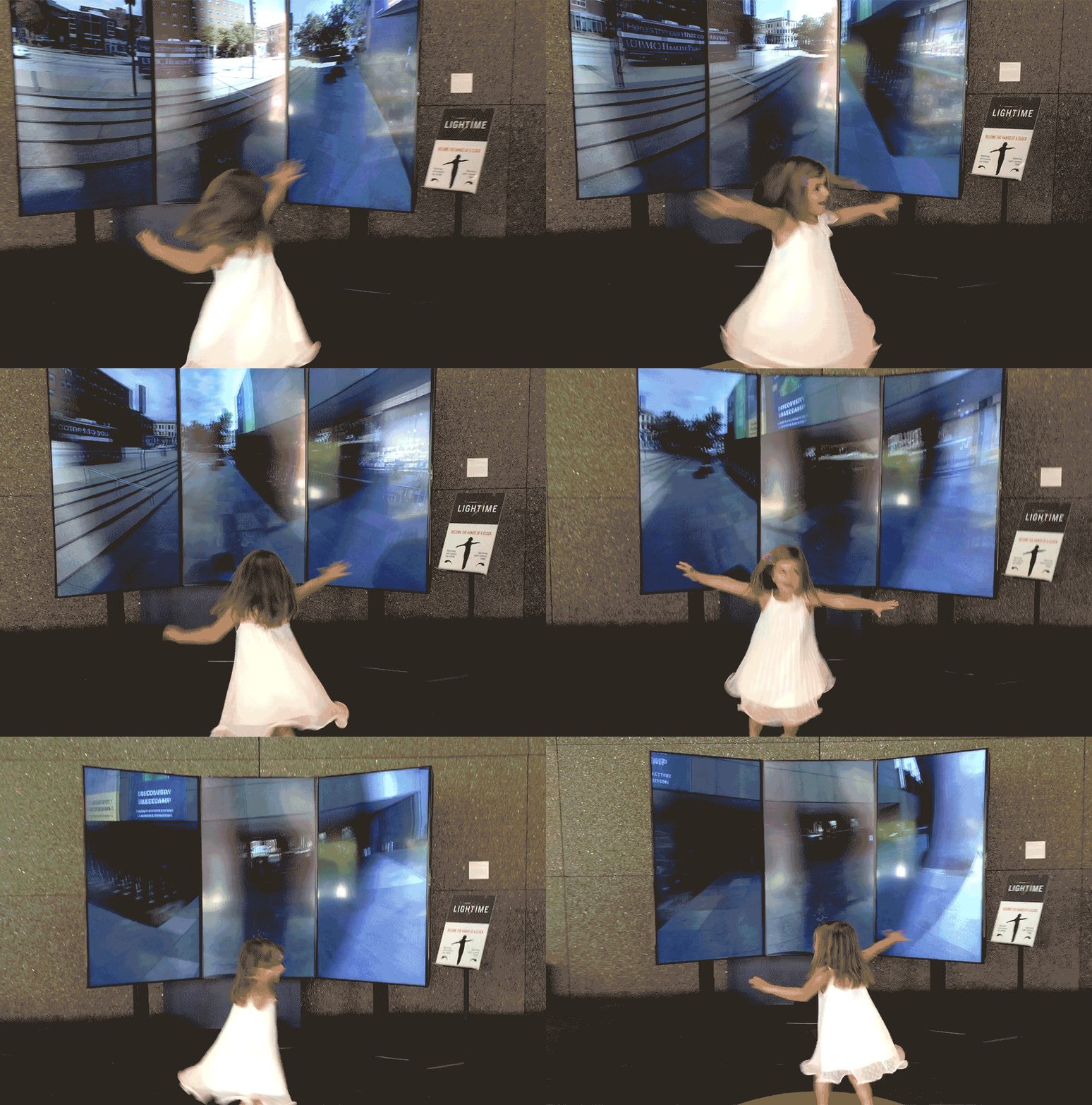
In order to detect the spinning of a visitor, we mounted a camera directly overhead in the ceiling. This sensing component of the project presented some very specific challenges for us, and Sam will be digging a bit deeper into this in a future blog post.
###The Current Moment
Coming out of the discovery sessions with CMOA, it became clear that the museum wanted to delicately walk a line between embracing selfie culture and moving beyond it. The museum wanted visitors to be able to see themselves in the clock, but also wanted to convey stories in addition to personal likenesses becoming part of the visualization.
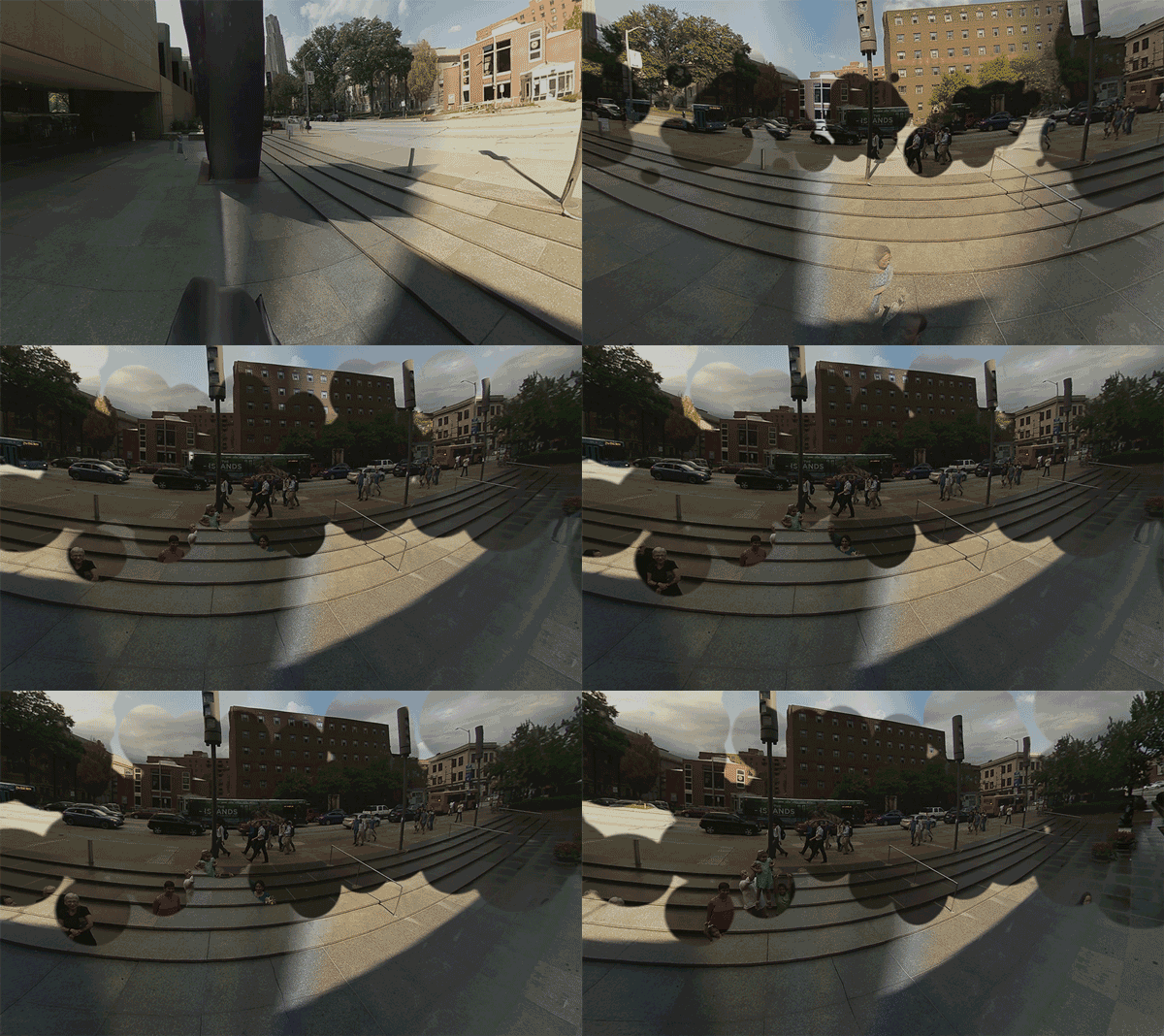
We addressed this complexity by creating something we refer to as The Current Moment. Every five minutes, when the clock takes a picture outside the museum, the photo that was just taken emerges within the visualization in its entirety. This gives visitors the ability to see themselves in the clock and experience their participation in this current moment. The visualization is completely functional and useable while the current moment is appearing. After a minute, the current moment then dissipates and becomes a part of visualization’s remix.
###Is it Art?
This project is interesting to me because it effectively blurs the lines between art object, gallery interpretation, marketing strategy and museum technology. In essence, we created a physical thing for an art museum. The physical thing occupies space twenty feet to the left of a Richard Serra and fifty feet to the right of a Henry Moore. The physical thing has a wall label just like the museum’s Monet.
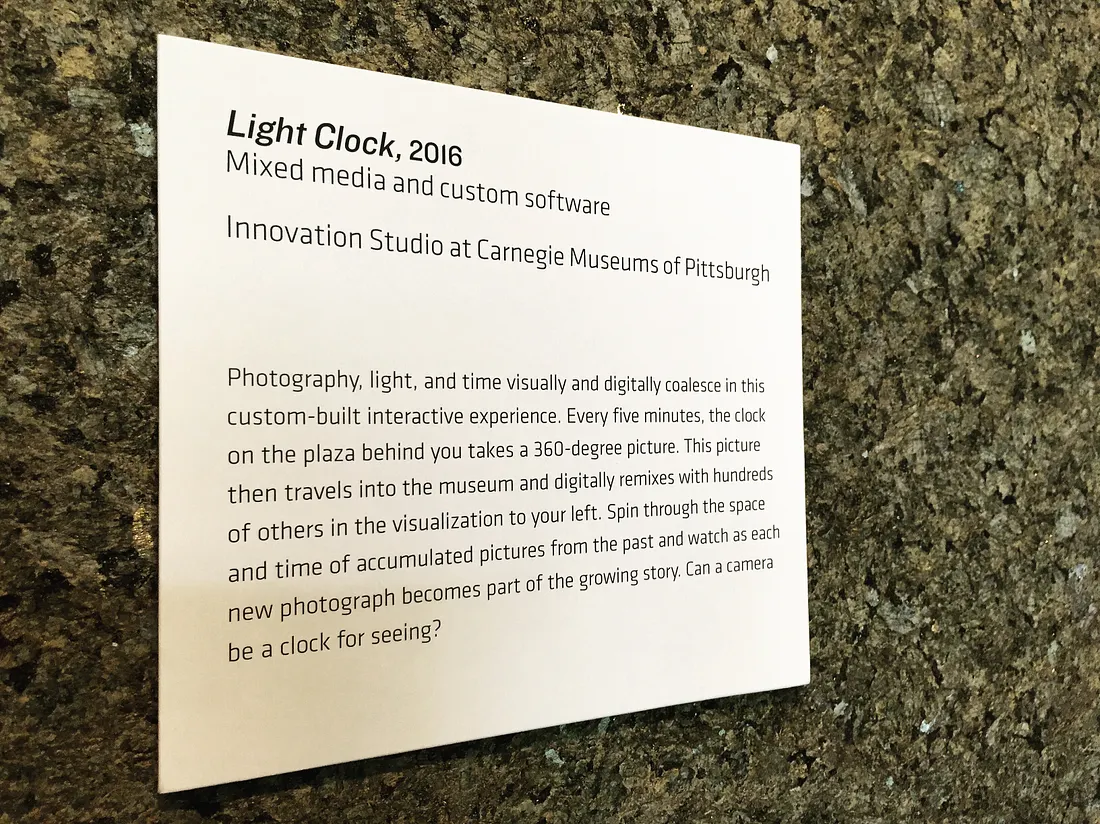
So is the Light Clock art? If so, it pushes the museum to consider where art objects can come from. To think the museum’s collection could regenerate from within is mind-blowing. If the Light Clock is not art, than what is it? Does it deserve a record in the museum’s collection management system?What happens to the clock 15 months from now when this cycle of the Initiative is over? Does it go into storage or into the dumpster? These are all meaningful questions. Questions that push us forward as a field. Questions I’m glad our museums are starting to discuss.
###Acknowledgements
This is the part where we thank people. A lot of people. So many people helped make this project a reality and without each and every one of these brilliant, creative and dedicated people the Light Clock would still be a figment of our imagination:
Jo Ellen Parker, Lynn Zelevansky, Divya Rao Heffley, Natalia Gomez, Catherine Evans, Dan Leers, Brad Stephenson, Matthew Newton, Bryan Conley, John Lyon, John Surloff, Kevin Gafner, Tony Young, Traci Moore and OnCam , Tommy Verdin and Verdin Bells & Clocks, openFrameworks and Arturo Castro, Brett Yasko, Tom Fisher, Ryan Sanderson, Ashley Czerniewski-Hagan, Nico Zevallos, Jason Fletcher, Golan Levin, Prasanna Velagapudi, Liz Deschenes, Steffani Jemison, Laura Wexler, Clear Story, MAYA Design, and Wall to Wall.
Support for the Hillman Photography Initiative is provided by the William T. Hillman Foundation and the Henry L. Hillman Foundation.