Category: Mindfulness
In my continued effort to eradicate algorithmic recommendations from my life, I am exploring alternatives to Spotify for music & podcast streaming. Current thinking is a local file library with iTunes Match enabled (music) and freestanding podcast app. How are y’all doing it? Advice welcome!

Finished reading: Filterworld by Kyle Chayka 📚
This book scratched the right itch for me at precisely the right time. It affirms my choice to walk away from corporate social media and go all-in on the indie or open social web. Chayka’s thesis asserts that proliferation of algorithmic recommendations flattens and homogenizes culture. He weaves a detailed thread from the origins of algorithmic thinking in ancient times, through the early days of Facebook’s News Feed which brought algorithms into every home, through the current algorithmic landscape that feeds from people’s time and attention at every turn. I highly recommend this book for anyone interested in mindfulness & digital culture.
For the love, not the likes
A couple months ago, my GPS watch stopped syncing with Strava. For whatever reason at the time, I was unable to restore the connection. I was also not in a position to spend $$$ on a new GPS watch, so since this disconnect was introduced my activities have no longer been pushing out to the popular social network for endurance athletes. As an active daily user who dished out boku kudos, I was initially quite bummed. And because I wasn’t posting to Strava, I stopped opening the app and reviewing what my friends were doing.
In the days since, I’ve noticed my mindset has been much healthier with respect to my exercise activities. So much of my time spent in Strava was me comparing my stats, paces and distances to others’. This resulted (subconsciously) in feeling pressure to always push harder, faster and further. I was losing the joy associated with getting outside and moving my body through the natural world.
In recent weeks, it’s been refreshing to get out for runs, rides and climbs simply for my own personal enjoyment, rather than feeding the ego associated with throwing down something epic for the kudos. It’s funny how this small technical hiccup has allowed me to recenter on my love for movement outside instead of the dopamine that came from the likes after the fact.
I really like Brad Stulberg’s six pillars to stay grounded in a crazy world:
- Adopt a mindset of tragic optimism
- Create daily and weekly anchors
- Respond, don’t react
- Stay consistent on what you care about
- Use behavioral activation
- Be rugged and flexible
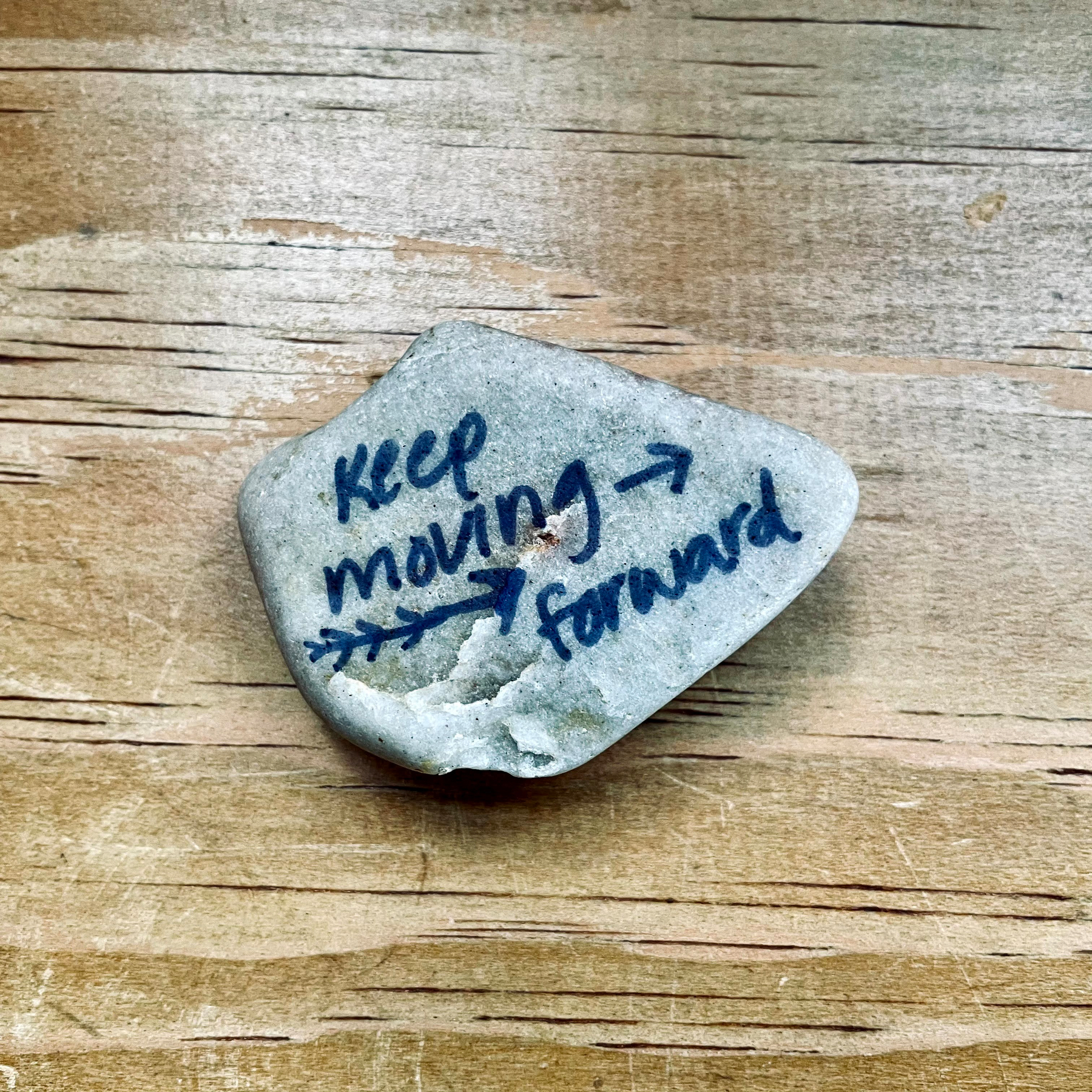
A dusting of snow fell overnight, giving my morning coffee an extra breath. The morning is still and quiet. Grey winter light hits the windowsill. 22 a Million on low play.
Inhale for today.
Election shit is still messing with my head pretty good. It was an intense weekend with the innauguration, the women’s march and the blasting of the press over crowd size on day one. I’m just really sad, mostly. And worried for the kids.
I quit all social media because I just can’t handle the negativity. Completely blew up my Twitter and Instagram. The echo chamber of fake everything. My brain and soul need some quiet. Space to breathe.
Still feeling blurry. The election hangover and Monty’s failing health have my mind elsewhere.
Need to focus on silent making. Reflective creating.
Need to keep my media bubble in tact. Someday I will share again.
We received a very thoughtful email from Elliott’s 4th grade teacher. She praised him for being compassionate with a classmate who is hearing-impaired. I am thankful that we are raising such a kind and thoughtful and compassionate little man.
Fault Lines
Innovation starts on the fringes. It germinates on the edges and festers in the shadows. It begins below the surface where the dissidents and dissatisfied reside, and it is from these depths that seismic shifts occur.
These shifts rarely happen slowly and incrementally. We may think of them as glacial, but the historical evidence suggests that change of this scale is rapid and transformational. Subterranean ideas take shape and take hold quickly inside the earth’s core, and they begin their rise to the surface through fault lines and volcanos. And then, when enough pressure and momentum has built, the earth gives way to new land formations upon which these new ideas can stand tall.
A question I regularly ask myself and now pose to you: Who’s your core and what’s your fault line?
Let’s shake the world.
Juxtaposition
Two years ago today, I experienced the saddest day of my life. It was a day I will never forget and a situation I hope no one else ever has to live through. Alternatively, eight years ago tomorrow, I experienced the happiest day of my life. It too was a day I will never forget, but in this case I truly wish everyone has a chance to feel the love that surrounded me on that day back in 2004.
Any time a juxtaposition of extreme emotions is compacted into a turbulent timeframe, it creates a great deal of internal tension for us. For me, these 48 hours embody a great conflict. I consistently find myself questioning the appropriateness of my feelings. How can I be simultaneously happy about this one thing and so very sad about this other thing? Why am I letting this cloud of negativity cast its dark shadow on my brilliant memories of pure joy? In all honesty, I don’t have the answers.
What I do have, though, is a vital macro-view of this 48-hour window — the ability to step back and analyze its essence. Through this window, I see the ebb-and-flow of the universe captured in a sort of time-lapse. This juxtaposition shows me the importance of mindful balance and non-attachment. It shows me that lives can be irreversibly altered in an instant and that nothing in this life is permanent. It wrangles up and presents to me the complete spectrum of all the possible feelings and emotions that exist in this world. It swallows me in an ocean of thought where tides bring and take without judgement.
This juxtaposition has taught that the past and the future do not exist. There is only this moment; there is only now. Nothing more and nothing less. Realizing this, I’ve learned to cherish every waking moment. I drink in my surroundings and live fully and completely in the present. I hold my friends and family close, and make sure they know I love them.
Only by living this way can I weather the most violent of juxtapositions and remain in a place of complete peace.
When you’re hungry, make fire.
For three weeks, my family has been living without a kitchen. We are in the middle of a complete remodel that involves taking the walls down to the studs and the floors down to their joists. This project not only impacts our kitchen, but also the adjacent dining room. The heart of our home has been rendered unusable. While progress is being made, it is slow due to the complicated nature of many moving parts.
The kitchen, when complete, will be wonderful. In the interim, though, we are living with a refrigerator in our family room and our dining set — with all associated plates, glasses and kitchen supplies — filling our guest room. Our family routine has been eradicated and we have become very resourceful when it comes to preparing food and sharing family meals.
In a way, I feel like we’ve been camping in our own home. We don’t want to succumb to the unhealthy lure of convenience sold by TV dinners and fast food, so we’ve meticulously been planning our meals to fit our busy schedules. We’ve gotten creative with ingredients and resorted to an outside grill to cook mostly everything.
If it’s raining at dinner time, I cook in the downpour and try to notice each falling drop as it strikes me.
Living without normal modern amenities, however temporary, is a healthy wake-up call. Sometimes I think we become numb to the concept of convenience. Hot? Turn on the A.C. Need a gallon milk? Jump in the car and drive a few miles to the store. Need directions? Google it on the go. These are the times in which we live.
Technology promises progress, and with that comes convenience. But when technology and convenience are removed from the equation, we are left with same problems — problems that can be equally answered using lowest-common-denominator solutions. Sometimes the answer is so simple.
When you’re hungry, make fire.
The Nest
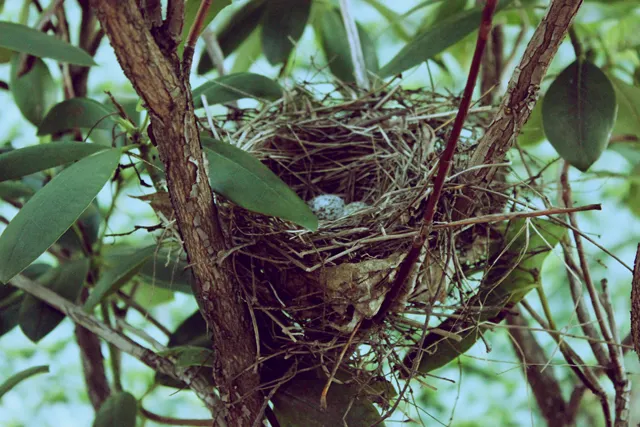
It’s early and I’m still half-asleep. I’m in the midst of my morning coffee protocol when I suddenly catch movement out of the corner of my eye. A brown blur with a crest of red, she moves in fits and bursts delicately forming a bowl of earth and straw outside my window.
The days have just gotten longer and we are approaching our dodge with the sun. She is preparing; she is making a home.
Days pass and I watch her create this nest. Every now and then, she’ll catch me peeking out the window and stop for a moment. Our eyes lock and then release with an unspoken agreement that neither wishes the other harm. She is meticulous, as many mothers are with matters of the family. She works tirelessly for the future, flying nameless random patterns in search of material to craft her bed.
They’re coming. I can feel it.
I awake the next morning to find some additions to the nest. Three ocean-tinted, speckled, chalky eggs have arrived overnight. The mother is proud, there’s no question. In an instant she’s gone from scavenger of building supplies, to protector of her fragile packages. She settles in and incubates.
For several days, the mother stays with her eggs. A trait of protection, she only leaves for seconds at a time. The weather has also turned cold. She has become the furnace.
Each morning, coffee in hand, I peer out the window to see if our new flock has arrived. And each morning the mother sits in silence. She eyes me with the same look my mother used to have. “Patience,” she conveys. Just when I thought the shells were in penetrable and void of life, I notice new movement in the nest.
The first egg has hatched. With beak inverted toward the sky, the new chick greets the world with an open mouth. She is hungry for her first meal and anxious for her siblings to join her. The mother is absent, but only for a moment until she returns with some nourishment for the babe.
I almost consider taking the day off from work to watch the other two eggs hatch, but several meetings are scheduled so I have to leave. Several times that day, in those very meetings, I catch myself wondering if the triad is complete. When I arrive home that night, I find it to be.
Three perfectly fragile baby chicks. They were all beak and full of cute.
The next couple of days pass and the chicks grow slightly bigger with each sunrise and cup of morning coffee. As they get stronger, their chirping grows louder. They are now fully capable of elevating their heads above the nest. The peek left and right, but ultimately end up back in the all-too-familiar position of beaks in the air, mother providing. When she isn’t feeding, she continues to warm the home.
As the chicks grow, I imagine watching as they emerge from the nest with fresh feathers and take that unpredictable leap into flight. I imagine them soaring with beaky smiles and playing like flying children would.
But that would never be the case.
I’m not sure how many days it was after the chicks arrived that I came home from work to find the nest disheveled and disturbed. No chicks. No mother. There had been an incident. There had been a struggle.
“Hello? Mr. Inscho? There’s been an accident.”
I won’t let myself imagine or consider the circumstances that took the chicks away from this world, just as I can’t dwell on the darkness in areas of my past that are filled with loss and despair.
Sometimes life has plans other than our own intentions. We are only passengers.
What I will do, though, is hold close the way our eyes met during those first few days and the connection we experienced in those quiet morning moments. I’ll cherish the opportunity to be a part of this mother’s dedication to her family and I will forever remember my vision of them flying off into the powder blue sky.
In Praise of an Amateur Approach
There was a time in my life when I aspired for expertise and the notoriety that came along with it. Early on in my career, I read lots of books about best practices (whatever that term means); I attended professional development workshops led by marketing experts who shared tips, techniques and best practices (there’s that term again); and I worked tirelessly toward developing a knowledge base I hoped one day would lead others to describe me as an expert in my field.
As I look back, these goals were extremely misguided. My efforts payed off, though, and the phone started ringing off the hook with invitations to speak about my work. I traveled far and wide to conferences and universities and meet-ups, waxing technological along my way to becoming a sharer of practices, best or otherwise.
This was all well and good until I realized what really made my work special and why people wanted to hear about it. Quite simply, I was not the expert people thought I was and the projects I created were not templated best-practices. Rather, they were playful experiments that valued humans over technology and meaningful connections over metrics.
In the early days of participatory and/or social media, there were no experts (and I would argue there still aren’t). We were all flying by the seats of our pants in an exciting, reckless and lawless wild west now known as the Internet. I was lucky to be one of a small group of rogue non-profit technologists who formed a kind of professional collective, regularly swapping war stories about projects that worked out well, in addition to projects that ultimately crashed and burned. This neo-collaborative environment fostered a freedom to experiment in a space without limitations. It was extremely conducive to producing uniquely creative work.
We ignored marketing metrics and built initiatives that flew in the face of the newly emerging, self-inflicted gurus. On paper, the projects shouldn’t have been effective, but they were. We were operating in new territory — one that had no textbook, let alone textbook author.
Upon realizing I was no expert and the projects garnering most attention were essentially public experiments, I became extremely conflicted wearing the costume of an expert. Who was I to speak authoritatively about these emerging technologies?
Asking myself hard, inward looking questions caused my professional world-view to change overnight. I stopped accepting offers to speak about my projects, in favor of sharing my experiences with those who have specific questions. To this day, I’ll happily discuss my work with people who are interested or readers who email, but I will never again put myself in a situation that delineates between expert and non-expert. I’m happy to forever consider myself an experimenting amateur.
There is something to be said for approaching one’s work from the perspective of an amateur. They operate with curiosity, openness, and an undeniable aire of possibility. There are no limits to their creativity and ingenuity is engrained within them. Amateurs participate in activities for the simple joy of doing so, not for a paycheck. They ignore rules and are not intimidated by failure.
Just consider the progress that has emerged from ignoring rules and popular conventions. We would be without innovations like Post-It Notes, Corn Flakes, the Pace Maker, Penicillin and countless others were it not for free experimentation and happy accidents. I don’t place my work on the same pedestal that these developments stand upon, but I do feel the best projects are those that force us to adapt to new paradigms and think differently about our environment.
Experts, on the other hand, thrive on stable existence. They live inside convention, measurement, regulations and best practices. With respect to technology, experts believe their methodology is the stuff of authority — a prescription for replicated success — which is rarely the case and often times not.
I think it’s important to differentiate between a lack of expertise and a lack of desire for information. These could not be more different. While amateurs do not possess unparalleled expertise in a subject, their thirst for knowledge about the subject cannot be easily quenched. To an amateur, there is always something more to learn.
In my personal practice, I continue to employ an amateur approach. It’s why I hash out crazy ideas like this here on the site. It’s why I only work with partners who embrace this philosophy. It’s why I admire other people making crazy unique work in the space and invite them to be guests on the podcast each week. I want to know more. I want to grow as an artist. I want to soak it all in. While not an expert at anything, I am hungry for experimentation and greedy for the fantastic.
And that’s enough for me.
Smaller. Slower. Less.
Bigger, better, faster, more. These are the benefits technology promises us. They are promises of the future. A commitment toward progress.
Larger hard drives with ever-growing capacity appear in shiny new devices at every turn of the product cycle. Information flows at a rate that makes many feel as if they are wrapping their mouth around the end of a fire hose. We celebrates excess at a level never before experienced in western culture.
Our television screens have more surface area than our dining room tables. We walk around with pocket-sized personal computers that provide unlimited information at our fingertips, yet we no longer remember phone numbers. And thanks to GPS navigation, we have no idea where we’re headed until we’re well on our way.
Bigger, better, faster, more.
We suffer from elephantiasis of advancement. And we continuously crave even more. More friends. More disk space. More followers. More apps. More page views. More “Likes.” More pixels. More channels. More downloads. More data. More features.
More caliber per capita.
Bigger, better, faster, more. Of these four words, only one is truly qualitative.
Many believe we’re better off thanks to technology. I would be foolish to deny the progress made possible through technological advancement. Diseases have been cured, disasters have been reported and dictators have been overthrown, thanks in great part to technology. Those are all amazing things. I’m sure thousands of similar examples exist proving the benefits of advancement.
But what about us? Is technology making us better as human beings? I’m not so sure, but I suppose that depends upon your subjective definition of better.
Experiment: if you live or work in an urban or suburban area, take a look around you the next time you’re walking down the street or at the mall. Take note of the number of people staring at a mobile device. The next time you are in a café, count the number of people with a laptop accompanying their latté. There is now a generation that knows only the connected way of life. The attached life.
And I’m as guilty as the next person.
I have a difficult time believing the attached life is the better life. It is impossible to avoid the digital aspects of modern society, however non-attachment and the practice of living in the present can cooperate alongside digital culture. If we reject technology’s promise of excess; renounce the ideas of bigger, better and more; and focus on our own personal concept of what better is (and should ultimately be), we can live in harmony with technology.
Smaller, slower, less. And better. Those are the ideals to which I am working.
Running in Silence
I am a runner. I can say that today with confidence, but it wasn’t always so.
When I started running just over a year ago, it was a struggle. I’ve always considered myself to be in relatively good health, but I wasn’t the most athletic person. I was active, but not an athlete. Plain and simple, in the beginning, each stride was painful. A fifteen minute light jog was nearly unbearable, torture even.
During those early days, when I was fighting hard to finish an exhausting three-mile run, my personal motivators were largely technology-based. I brought my phone along with me on those cold winter wars to fire music into my ears that powered my feet to keep moving, step after step, mile after mile. I tracked my progress with Runkeeper, a GPS-enabled application that measures mileage, pace, calories burned and a slew of additional metrics. Runkeeper’s sultry-voiced narrator would occasionally chirp distance and pace updates into my earbuds, letting me know just how far I had gone, and how much farther I had yet to go.
With consistency came comfort. As the runs became easier, I upped my distance to include one long run per week. This caused my outings to last longer, sometimes longer than 90 minutes. On these longer runs I listened to a regular rotation of technology podcasts from the 5x5 and 70 Decibels networks.
While the music, tech musings and automated metrics kept my mind from focussing on the discomfort my body was feeling, I also discovered that this constant connectivity (even while in the middle of the woods on a trail run) was keeping my mind from appreciating my surroundings in those moments, following an exploratory train-of-thought around professional ideas and concepts, or simply experiencing the silence and patterns in my breath.
The technology had created a barrier. I was distracted, no longer fully aware and I became more interested in outcomes, results and metrics, than process.
Realizing this, I made the decision several weeks ago to eliminate technology during my runs. No music, no podcasts and no Runkeeper updates. I would leave my phone at home and become one with my path and my thoughts.
On my first run without technology, I remember noticing the discomfort was gone. I was several miles into the run and feeling fine. I let my mind wander to any thought that entered it and I explored those thoughts without limits. I was aware of the nature surrounding me and I was in tune with my breathing.
Distance didn’t matter. Pacing didn’t matter. Alternatively, my experience during the journey mattered. Process mattered.
Since embracing the silence during my runs, I’ve had a lot of time to think about Static Made (as a whole) and specific client projects in a setting that’s completely removed from a display screen. Pondering technology in the absence of it is liberating. It’s been refreshing and has allowed me to develop creative ideas in a way not inherently tethered to technology.
The lesson for me here is this: technology should never be a tether, but rather the vehicle through which tethers are cut. Outcomes are definitely important, but the process of exploration should enjoy equal footing. The process is journey to the desired result and space in which you can create without limits.
Can A Smart Person Believe In God?
I was watching Heartland w/ John Kasich the other night and an interesting topic was being discussed. The segment was entitled, “Can a smart person believe in God?”. Author Michael Giullen was the guest expert of the segment, having just penned a book of the same name. The discussion made me ponder the question. Is an intelligent person able to believe in a supreme entity that displays no physical proof of existing in the first place?
I first thought about the question subjectively. I consider myself somewhat intelligent, although some of you might disagree. I also consider myself a spiritual person, albeit not conforming to one specific organized religion. If I must be labeled, I would consider myself Tibetan-Buddhist, only because it falls in line with MY belief system. As to address the question stated above, I feel one would be a fool to not concede that there is some additional force at work in this universe other than that of humans. Be it nature, be it Allah, be it Karma, be it God, be it science. To suggest that a greater force does not exist displays ignorance, narcism and stupidity.
I think that religious people are deemed “not smart” or ignorant because the overwhelming majority condemn beliefs that are not in line with their own. This, in turn, makes them seem less intelligent because they are unwilling to understand a different point of view. I’ve been told many times that I will burn in hell because I do not accept Jesus Christ as my lord and savior. In my opinion, we mislabel religious people as ignorant. They are not ignorant because they believe, but because they are intolerant.
I understand that certain religions are less accepting of others. It shouldn’t be that way. If you look at a cross section of the major religions on this planet, they all teach tolerance, forgiveness and love. All religions are beautiful in their own right. It’s when intolerant fundamentalists hijack a belief system that religion gets a bad name. So to answer the question, I believe that a smart person can believe in a God-like entity, but it is a truly wise person that also realizes there are, often times, more than one answer to a question.